Backpacking With a Dog: Complete Guide to Gear, Training, and Safety

Backpacking with a dog can be incredibly rewarding, but it takes more planning than heading out solo.
Before your first trip, it’s important to build endurance, practice overnight camping, and have a solid plan for safety and emergencies.
I started backpacking with my dog a few years ago, and it’s quickly become one of our favorite things to do together.
This guide covers exactly how to prepare, what gear you need, and how to keep your dog safe in the backcountry.
In this post:
- Preparation for your first time backpacking with a dog
- Essential backpacking gear for dogs
- Dog backpack weight calculator
- Safety for dogs in the backcountry
Disclaimer: This article features some affiliate links. I only endorse things I’ve personally used or that come highly recommended by trusted peers. If you purchase anything I mention using my referral links from Amazon, REI or other retailers I may receive a small commission. However, there is never extra cost to you. You can read more here. Thank you for your support.
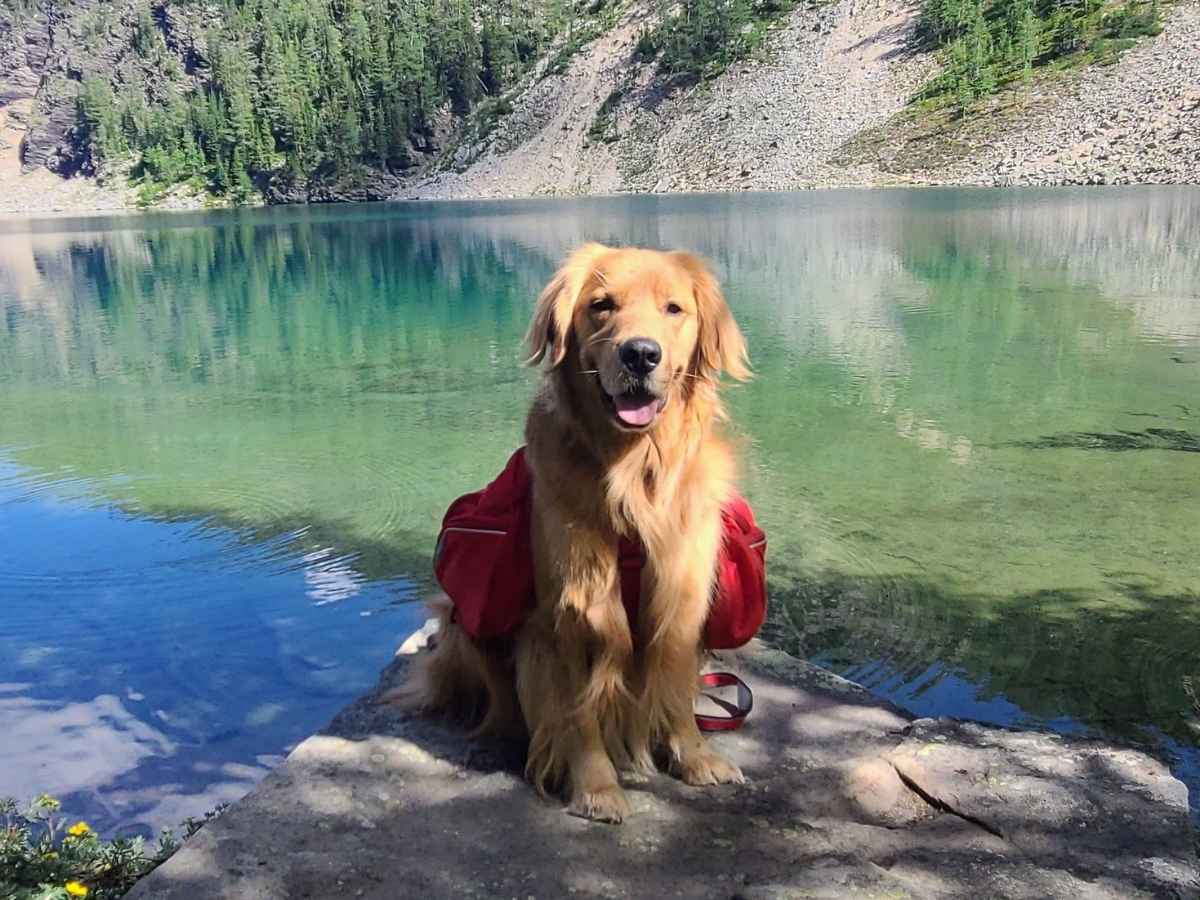

Meet Oscar! My backpacking dog 🐶⛺
Essential Gear For Backpacking With A Dog
My first rule when taking my dog backpacking; he will be as comfortable (or more) as I am.
That means he needs some basic gear. You do not need a lot of things for backpacking with a dog, but I recommend you invest in quality items so they’re comfortable to wear and hold up well.
TIP: I’ve linked all my recommended gear for backpacking with dogs on my Amazon page here.
1. Dog Backpack

For shorter trips (2 nights or fewer) you can skip this and carry everything for both of you in your own backpack.
For trips longer than 2 nights, a dog backpack is essential and allows them to safely carry their own gear.
If you can only invest in one piece of top quality backpacking gear for your dog, their backpack should be it!
The wrong backpack can cause your dog chafing, blistering, and discomfort. Look for quality materials and design. Fit is equally important to prevent chafing.
My dog backpacks with his Ruffwear Palisades Dog Pack (Amazon) (REI) and absolutely loves it. As soon as I pull it out of the closet he goes nuts with excitement — he knows his backpack = adventure.

I did a lot of research before investing in the Ruffwear Palisades Dog Pack. A few reasons why I chose it over others:
- Removable saddlebags – easy to take off during for trail breaks, the harness stays on
- 5-point adjustment system – completely customized fit for comfort
- Soft-wrapped buckles – prevents chafing
- Multiple pockets, zippers & clips – easy to organize and distribute weight equally
While it’s on the higher end of the price range, nothing was overlooked in the design of this top quality dog backpack. We’ve had it for years and it’s still in brand new condition (although a bit dirty from love).
2. Best Tent For Backpacking With Dogs
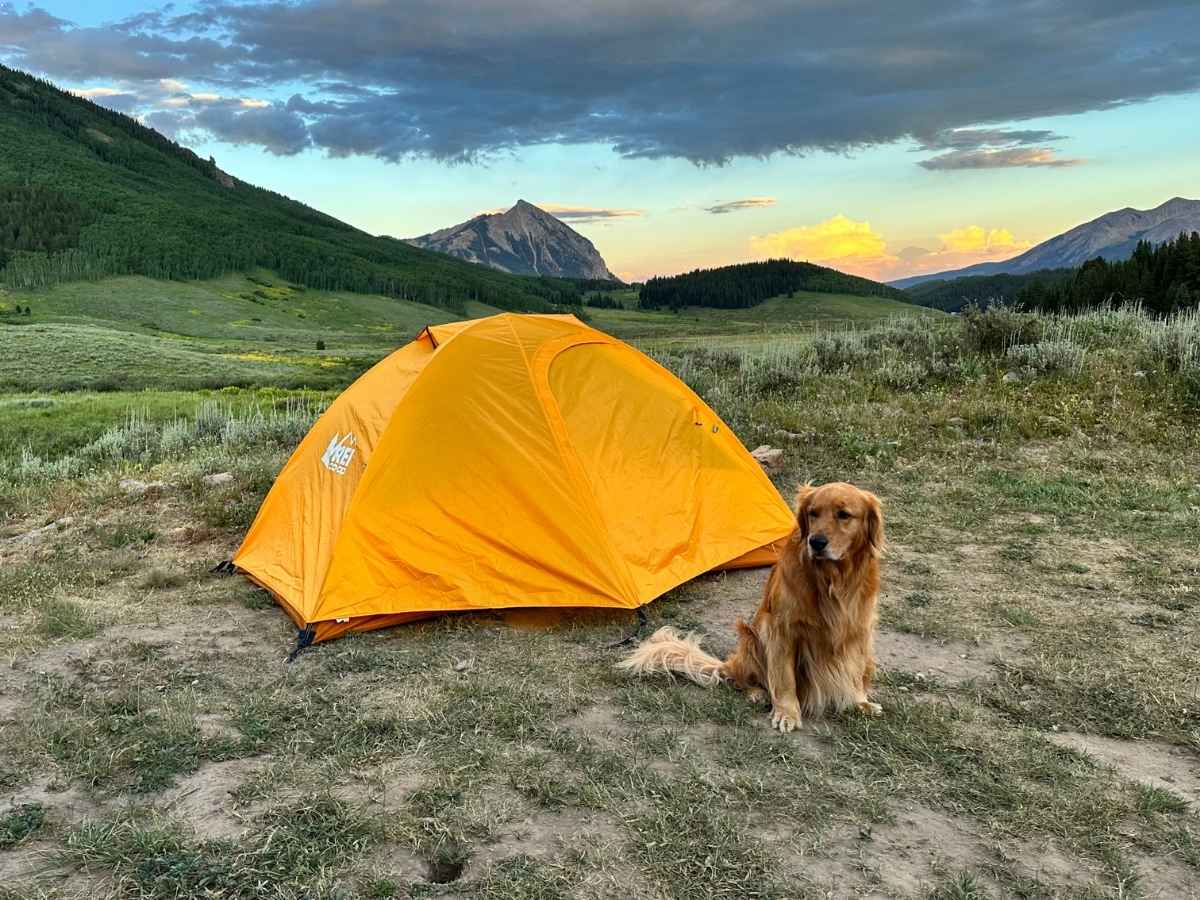
First, you’ll need a tent that is large enough for you and your dog.
Add the number of humans and dogs to find the correct size tent. For example, a 2 person tent is enough space for 1 human and 1 dog.
I use the REI Trailmade 2 tent and absolutely recommend it as a good beginner to intermediate backpacking tent.
It comfortably sleeps me and my dog, and the vestibules are great for keeping outside gear dry. It’s about 1 lb heavier than the ultralight tents, but hundreds of dollars cheaper.
Save this article
Enter your email address and I’ll send it straight to your inbox!
You’ll also receive my monthly newsletter filled with helpful outdoors tips.
3. Backpacking Dog Bed
Next, you’ll want something comfortable and insulated for your dog to sleep on.
I have found that giving them their own bed will keep them off of yours. Dog nails and inflatable sleeping pads are not compatible.
The best backpacking dog bed I’ve found is my Nemo Switchback Sleeping Pad (Amazon) (REI). It’s very affordable and lightweight, plus it’s insulated and extremely durable.
Mine serves dual purposes while backpacking with my dog. During the day, it’s a clean, dry, comfortable spot for me to sit. At night, it’s an insulated backpacking dog bed.
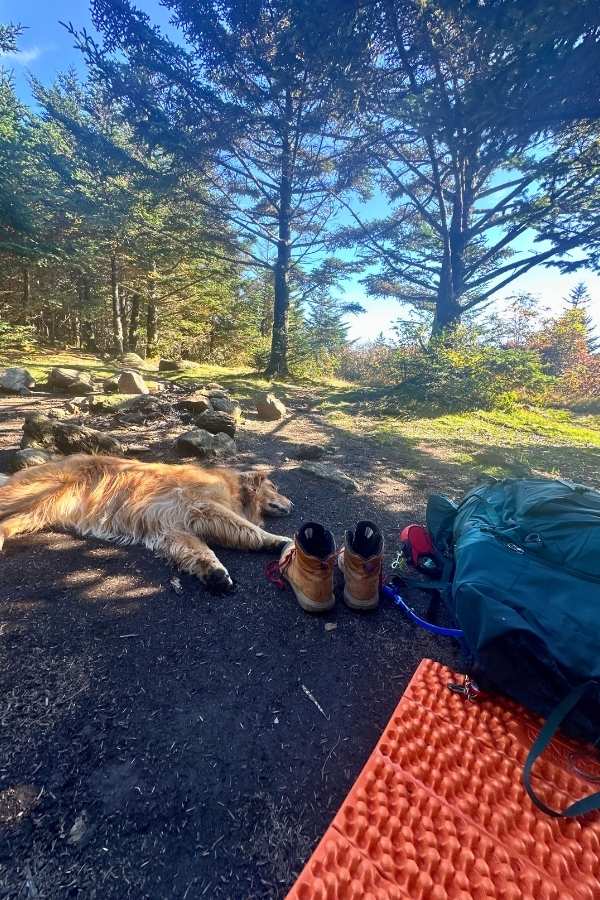
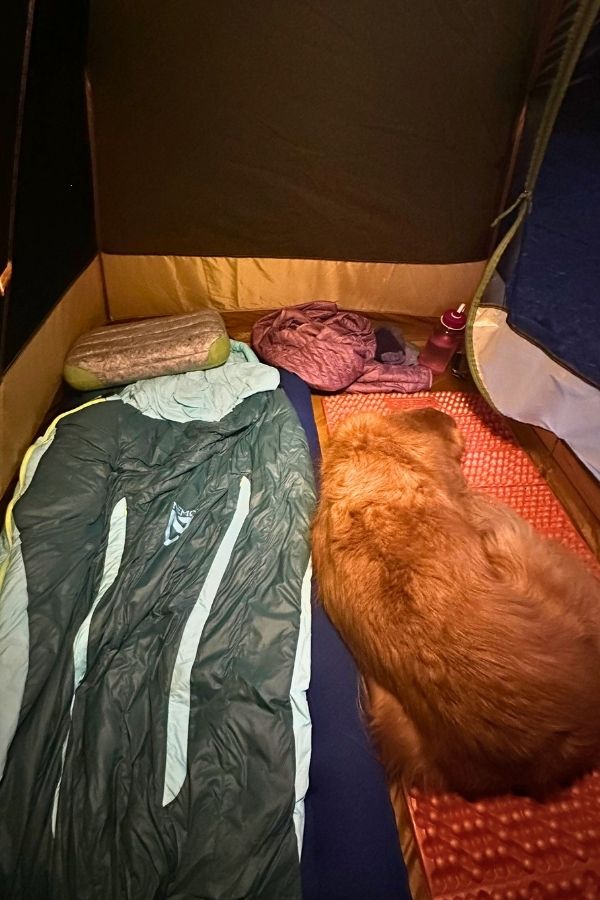
My dog won’t stay under a blanket, so for colder trips I pack his Ruffwear Overcoat Fuse Jacket (Chewy) (Amazon) because it will actually stay on him while he sleeps. One of your extra layers, like a fleece jacket, can also double as a blanket.
TIP: A lightweight backpacking towel is also a good idea to bring with. It also serves dual purposes; something to dry your dog after a swim, or a blanket at night.
<< Read More: Best Travel Towels For Backpacking >>
4. Leash, Collar & Harness
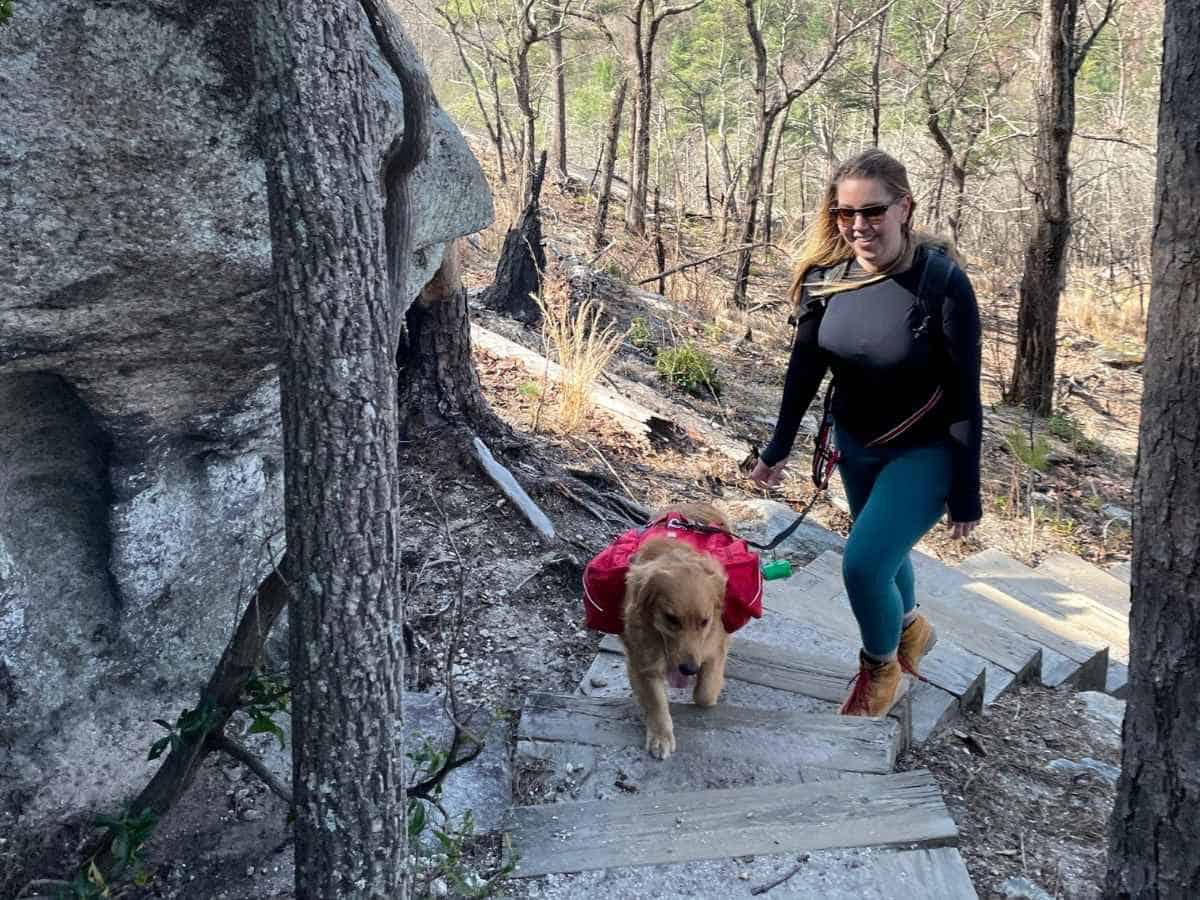
My dog hikes on a leash, even if it’s not required. This is more for his safety than anything else.
Being on a leash keeps him near me, so I’m more likely to spot trail hazards, like snakes. Sadly, we have experience with snake bites and it’s something I never want to experience again.
Second, it’s an indicator to predators that he’s with me. We’re a package deal, literally connected by a rope, and therefore he’s less likely to be attacked.
I prefer a hands-free leash so I can use trekking poles. My Kurgo 6 In 1 Quantum Leash (Chewy) (Amazon) is perfect for backpacking with my dog because it can be worn cross-body, around my hips, clipped to my backpack or as a normal handheld leash.


Hiking in a harness will put less strain on your dog’s neck. Our Ruffwear dog backpack has an integrated harness, but the Ruffwear Web Master Dog Harness (Chewy) (Amazon) is a good option if you’re not using a dog backpack.
At camp, the harness comes off and the collar goes on. This means he always has identification on him in case he gets spooked and runs off.
Make sure you have a quick-release collar, not one that has to slip over his head. If your dog gets stuck on something you want to be able to quickly release the collar.
TIP: I recommend a rechargeable LED collar (Chewy) (Amazon) so you can find your dog in the dark. They’re surprisingly useful.

5. Emergency Dog Harness
What happens if you’re 10 miles deep in the backcountry and your dog is injured and unable to walk? Can you carry them out? Do you have to leave them to go get help?
An emergency harness is crucial for backpacking with dogs. The time to buy one of these is before you need it.
There are a few options for emergency dog harnesses.
- Fido Pro Airlift – popular option, around $100
- Non-Stop Dogwear’s Dog Rescue Sling – more compact & lightweight, around $60
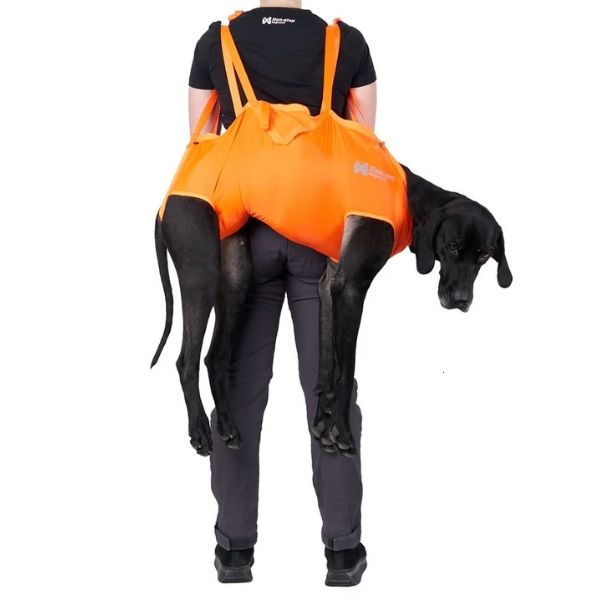
I opted for Non-Stop Dogwear’s Dog Rescue Sling specifically because it’s compact. The sling is small enough that I carry it even on regular neighborhood walks.
6. GPS Tracker
If you’ll be backpacking with a dog frequently, then a GPS tracker is crucial.
I had one of these on my dog while we lived in our campervan. We were camping in new places all the time. Finding his way “home” in unfamiliar places is harder, so the tracker gave me peace of mind I would be able to find him.
Only satellite-connected GPS trackers work reliably in the backcountry. Bluetooth and most cellular-based trackers are useless once you lose signal.
There are a few great GPS dog collars I reviewed here, but overall I think Tractive and Halo work best for most dogs.
Other Items Needed For Backpacking With Dogs
- Cable line for camp (simple rope works great)
- Carabiner (handy for many uses)
- ID tag + photo (in case they get lost)
<< Read More: Beginner Hiking Gear Guide >>
Dog Backpacking First Aid Gear
When you take your dog backpacking, you’ll need to add a few additional items to your first aid kit.
- Needle-nose tweezers – ideal for removing ticks, splinters, prickers
- Styptic powder – to control bleeding, especially for torn nails
- Vet wrap – for wound care
Hydrogen peroxide is also useful for cleaning wounds, and for inducing vomiting if they eat something toxic.
TIP: Hydrogen peroxide loses effectiveness when exposed to oxygen. Refresh your supply frequently and keep it in an airtight container.
Generally, dosing to induce vomiting is 1-2ml per 2 lbs. My dog is 70 lbs so a dose would be 30-60ml.
NOTE: Please, always consult your vet before making medical decisions about your dog. I am not qualified to give you advice, this article is based on my own experiences – take what’s helpful, leave what’s not.
I also recommend asking your vet for a dog-safe antihistamine recommendation, just in case they’re stung or have a bad reaction to something on the trail.
3 Training Tips For Backpacking With Dogs
I had a few unusual rules when training my dog that have come in very handy while backpacking.
1. Recall Training
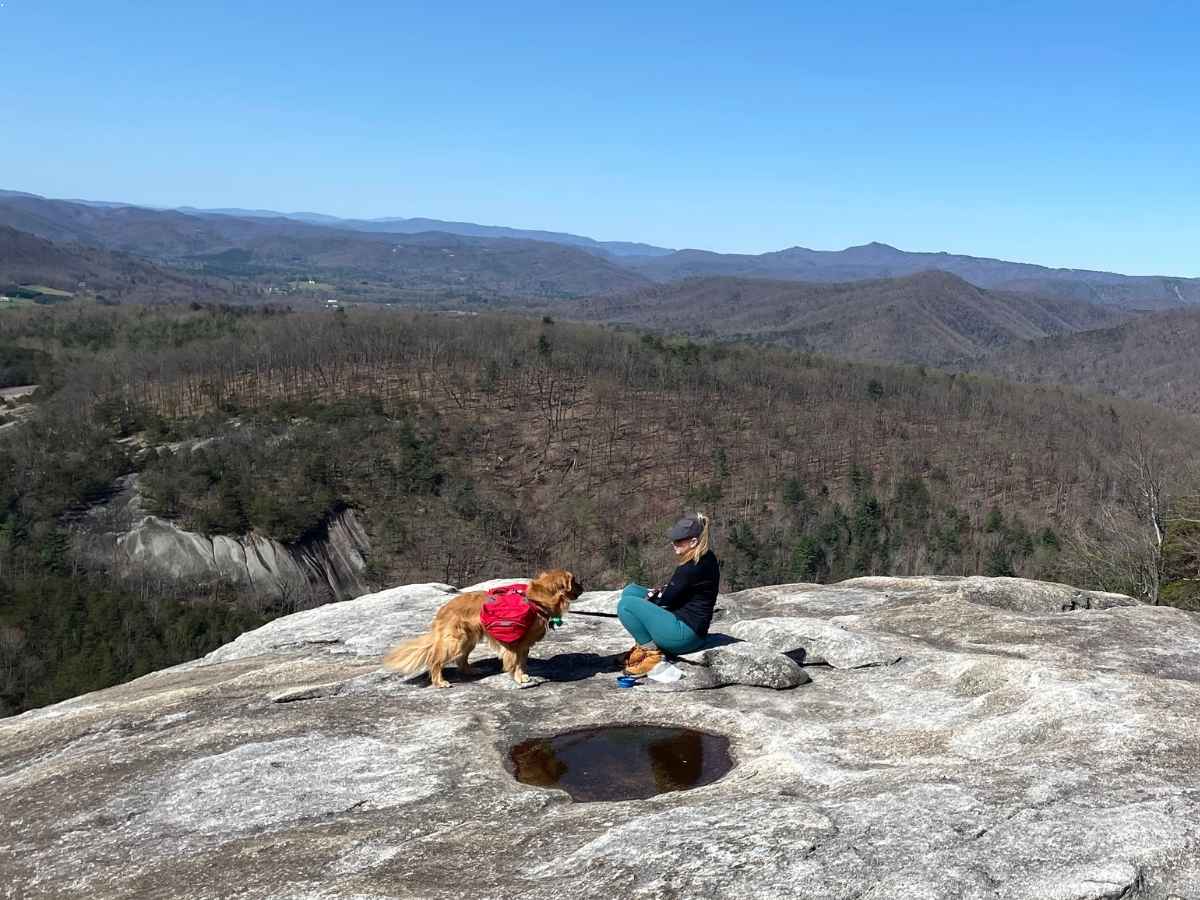
First, and most obvious, is recall.
This infinitely increases your dog’s quality of life, in addition to your own. If they can be trusted to come back when told, then they can have freedom to wander and explore when leashes aren’t required.
I prefer to hike with a leash, but once we’ve set up camp I allow my dog to move about on his own so long as he stays within eyesight.
2. Water Safety Training

Second, absolutely no drinking from ponds, rivers, lakes etc. Ever.
I’ve read too many gut-wrenching stories of dogs who drank from a pond with toxic algae blooms. Many times, you don’t know the water is toxic and by the time it’s consumed it’s too late to do anything. There is no remedy.
I’m also wary of upstream risks, like sick animals or chemical spills. No matter how clean the water looks, all drinking water is filtered.
I use a Platypus water filter (REI) (Amazon). It’s affordable, is easy to use, and lightweight.
TIP: Like most filters, these require some prep so be sure to run some water through them 24 hours before your trip otherwise it’ll be very difficult to get them to filter on trail.

3. Food Safety Training
Finally, nothing is eaten without permission. This prevents my dog from getting into something dangerous, like mushrooms or treats laced with fish hooks (I cannot believe that’s something I have to worry about…)
If it’s in his bowl (REI) (Chewy) (Amazon), he’s allowed to have it.
If it’s handed to him, he’s allowed to have it.
If it’s on the ground, he needs a verbal cue from me before he’s allowed to have it.
Of course, these training tips have to start long before you hit the trail, and you have to be consistent with them, even at home.
<< Read More: Pet Temperature Monitors For Travelers >>
Things To Consider When Planning A Backpacking Trip With Dogs
Before planning your first backpacking trip with a dog, think through terrain, water access, and your dog’s experience level.
Choosing the right route is one of the biggest factors in keeping your trip safe and enjoyable.
Terrain Type
Terrain matters more for dogs than most people realize. Pine needle-covered trails are much easier on paws than sharp shale or rocky scree fields.
Tougher trails should mean fewer miles. You’ll also want to anticipate a slower pace.
I use AllTrails to check reviews, photos, and the Surface Type widget to get a sense of what the trail is really like.
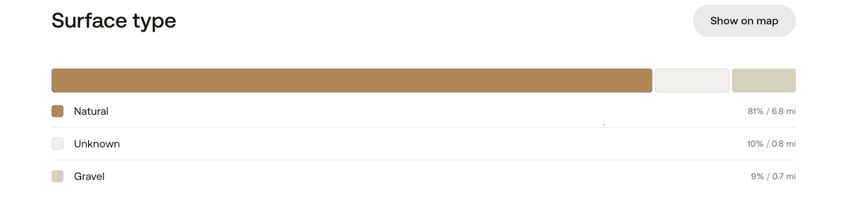
TIP: AllTrails+ includes safety features like off-trail alerts and realtime location sharing with family. I pay around $35/year and highly recommend it for hikers.
Access To Water
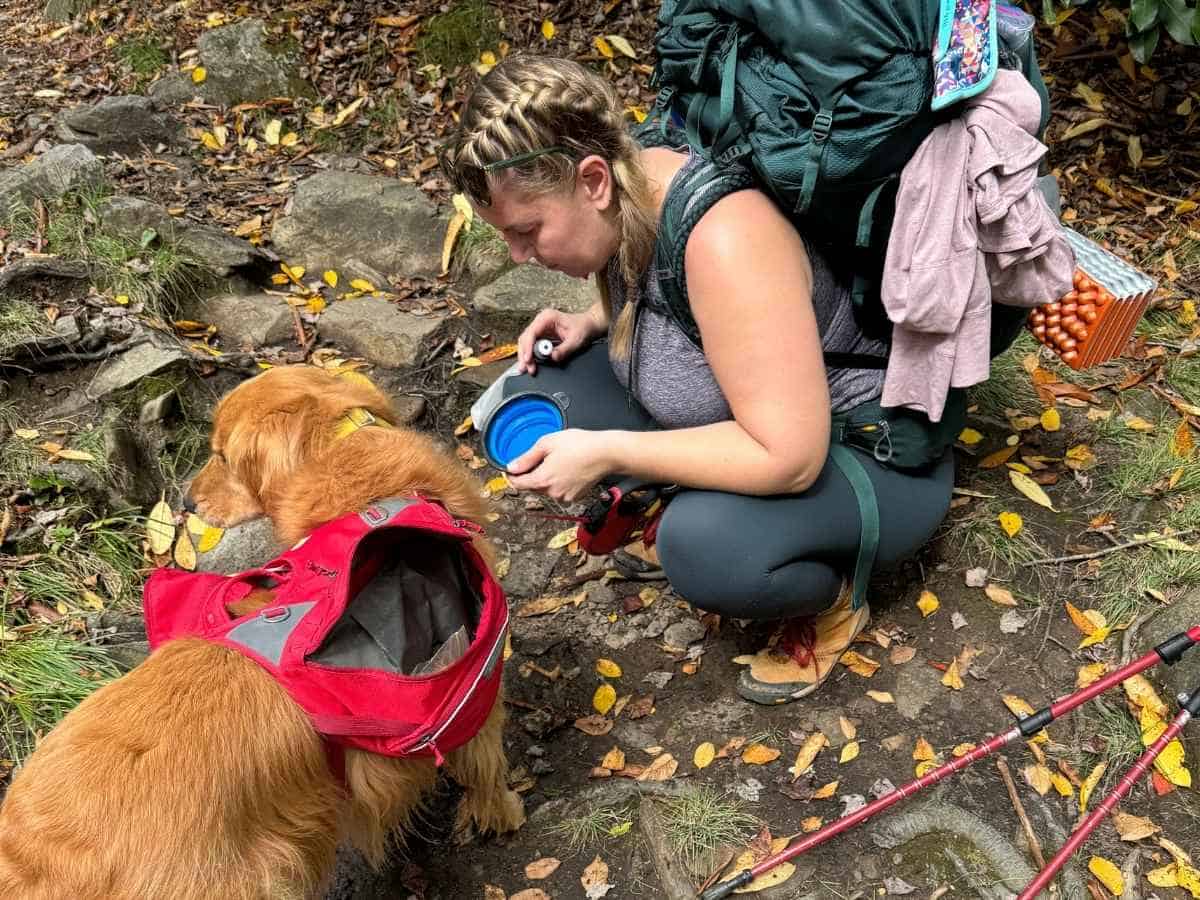
Have a plan for where you will refill your water.
Always confirm that water sources are flowing, especially in late summer. AllTrails reviews and ranger stations are the most reliable ways to check.
I avoid backpacking trails without regular water access. Between the two of us, we go through a lot of water, and long dry stretches mean carrying heavy loads.
I’m comfortable with 6–8 miles between water sources, but in hot or exposed areas I aim for 5 miles or less.
Skill Level, Endurance & Interest
Plan your backpacking route according to your dog’s skill level, endurance and interest in being outside. With time, you’ll be able to add mileage to your routes.
My dog would spend 24 hours a day outside if he could, so backpacking is a treat for him.
He’s very used to long hikes and varied terrain, but that endurance took time to build. Our first backpacking trips were short one-night outings with under 10 miles total.
Food Storage
The last thing to consider before taking your dog backpacking is how you’ll safely store their food at night.
You’ll need to consider this for your own food as well, so whichever method you choose should be large enough to hold all of your food, your dog’s food, and any other scented items.
Depending on where you’re backpacking with your dog, proper food storage will vary:
- Rat sack (Amazon) – lightweight, easy to pack, not rigid like a bear canister. Ideal for deserts or locations without larger predators.
- BearVault (REI) (Amazon)- rigid container, designed to be bear-proof. Ideal for bear country.
- Hoist system (Amazon)- ropes and sack to hang food out of reach.
I prefer to use my dog’s regular food while backpacking. Consistency in his diet prevents potential gastro issues on trail. He gets about 10% more to accommodate the increased activity level.
Always bring an extra day’s worth of dog food.
How To Get Started Backpacking With A Dog
Backpacking with dogs is much easier if you take small steps to get your dog adjusted.
Not only do they need endurance, they’ll also need to get comfortable with camping gear and anything they’ll wear while backpacking.
Break In Booties
Just like hiking boots, dog booties need to be broken in to prevent blisters and chafing.
I’ve found that soft booties are better for most terrain. They provide protection from sharp rocks and prickers without being rigid or causing blisters.
My favorite dog booties are the high rise ones from NonStop Dogwear. They stay on my dog’s feet without slipping off and getting lost.
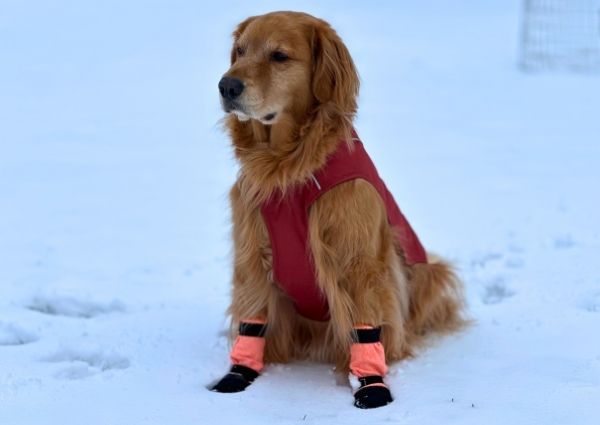
TIP: Paw balm, like Mushers Secret (Chewy) (Amazon), is great at bedtime to prevent cracked or dry paws. It is also great for soothing hot spots or cuts.
Dog Backpack

Your dog’s backpack is another piece of gear they need to break in and get used to wearing.
Have them wear the empty backpack at home for a few minutes before progressing to short outdoor walks (still empty).
Once they’re ok wearing the backpack for a few miles, slowly add weight. Ideally, your dog can carry 10-25% of their body weight.
My dog can comfortably carry 15% of his bodyweight in his backpack. On longer trips (over 8 miles per day), I drop his pack weight to 10% of his bodyweight.
NOTE: Ask your vet how much your dog can safely carry. I’ve seen recommendations range from 10% to 30%, but I truly think it depends on breed and activity level. It’s not a one-size-fits-all equation, so your vet’s recommendation is crucial.
Tent Familiarity
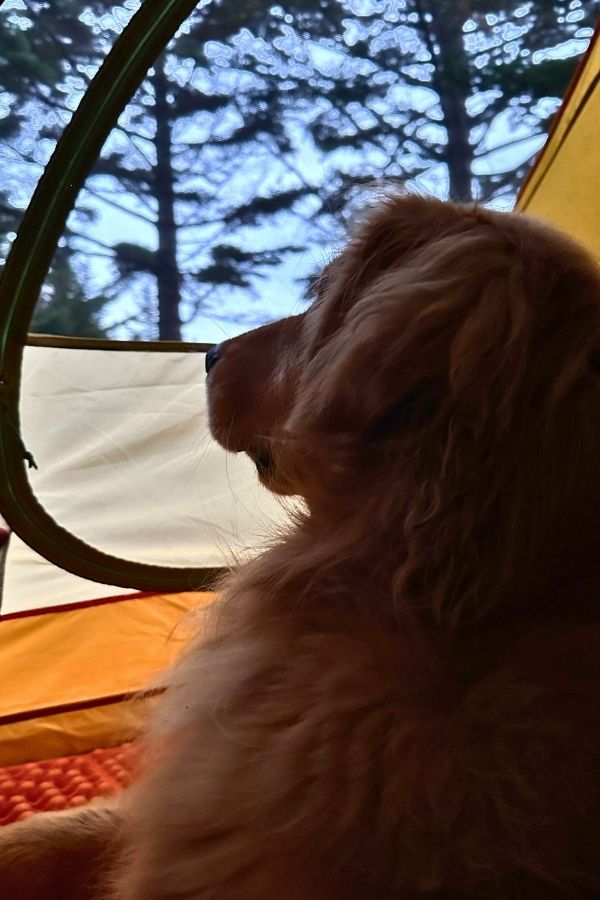
Additionally, if your dog is unfamiliar with camping they’ll need to get comfortable with a tent.
Tents, in particular, can be scary for dogs. They can make a lot of noise in the wind and move on their own.
First, set up your tent at home. Let them get used to it, and spend some time inside the tent with them.
Then, move it outside and spend a night together. Your backyard is perfect because they’re already comfortable there.
Keep progressing, introducing one new element at a time until your dog is totally cool with a tent.
Vet Visit + Updated Vaccines
Let your vet know your plans to backpack with your dog. If you’re making annual wellness visits to your vet, you’re likely already covered for most vaccines.
Vaccines you’ll definitely want boosted before taking your dog backpacking:
- Rabies – legally required in the US
- Lepto (Leptospirosis) – protection from bacteria spread through wildlife urine that can be transmitted through water sources
- Tick/Flea Prevention – a monthly preventative pill and/or Lyme vaccine
- Heartworm Prevention – monthly preventative pill
Depending on your location, some additional precautions may be recommended.
My dog takes Simparica Trio to prevent ticks, fleas and heartworm. I do not love the idea of a monthly pill, but we are far too active outside to risk tick-born illnesses (Lyme, Rocky Mountain Spotted Fever), parasites transmitted through Flea bites or heartworms transmitted through mosquito bites.
For our lifestyle, the benefits outweigh the cost… although I’m open to alternative options that are just as effective if you have any!
Tips For Backpacking With A Dog
Always be extremely aware of the temperature forecast. Dogs can overheat much faster than humans. They don’t have the ability to sweat, which is how we release body heat.
Know your dog’s limits, take breaks often, and keep a careful watch for signs of heat exhaustion.
TIP: Consider a cooling vest (Chewy) (REI) or cooling neck gaiter (Chewy) (REI) if your dog is prone to overheating.

Additionally, make sure your dog is microchipped AND you are getting routine scans. Microchips are known to move. So, while you think it’s between their shoulder blades it may actually be in an entirely different location.
My dog gets scanned at our annual vet checkups, just to make sure everything is working how it should.
Save this article
Enter your email address and I’ll send it straight to your inbox!
You’ll also receive my monthly newsletter filled with helpful outdoors tips.
More Resources For Backpacking With Dogs
Ultimately, you know your dog better than anyone else. Use these tips as guidelines, not rules. Pay attention to what your dog is comfortable with, plan routes accordingly, and don’t be afraid to adjust or turn back when something doesn’t feel right.
You can easily find all of my recommended gear from this article on my Amazon list here.
If you’re frequently traveling or camping with your dog, these guides may also be helpful: